Massacre Island: How Dauphin Island Got Its Original Name
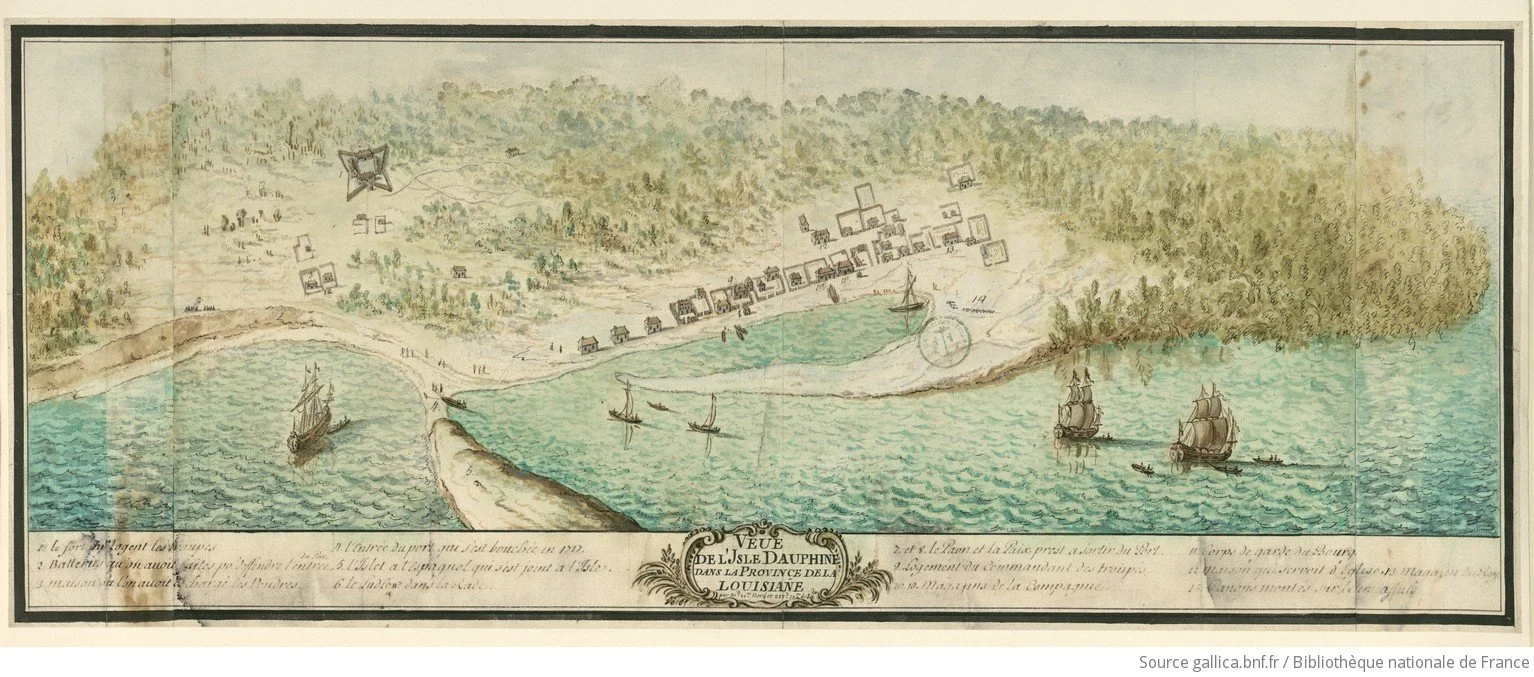
“Vue de l’Isle Dauphine dans la Province de la Louisiane,” early 18th-century French view of Dauphin Island.
Source: gallica.bnf.fr / Bibliothèque nationale de France (Public Domain).
Today, Dauphin Island is known as the Sunset Capital of Alabama — a place of beaches, quiet neighborhoods, and evenings painted in coral and gold along the horizon.
Long before it carried that reputation, however, the Island appeared in early French records under a far more striking title — Île du Massacre. Over time, that name faded from official use, replaced by one honoring royalty. Yet the earlier name never entirely disappeared. It lingered in print, in memory, and in local retelling.
The Island’s story did not change. Only the names did.
1699 — Île du Massacre
In January 1699, when French explorers first arrived along the Gulf Coast, they stepped onto an island already marked by time and human presence. What they encountered was not an empty shore, but visible signs of an earlier and violent struggle — human remains left from conflict between Native groups.
They recorded the name as Île du Massacre — Massacre Island.
Later retellings would embellish the scene into dramatic images of skulls piled high along the beach. Early accounts, however, speak more generally of remains found along the shoreline. Whatever the precise details, the name reflected what the explorers believed they had found.
The Island had now been entered into written history.
1708 — The Power of Naming
What is often overlooked is how quickly that name changed.
By 1708, official French records refer to the Island as Dauphin Island, named in honor of the Dauphin of France — the heir to the French throne, at that time Louis, Duke of Burgundy. “Dauphin” was the formal title given to the king’s eldest son.
In less than a decade, the Island’s recorded identity shifted — from a name born of violence to one reflecting royal authority and colonial claim.
Massacre Island became Dauphin Island.
Yet the earlier name did not disappear. It lingered in memory, in retellings, in local tradition.
Names carry power.
They shape perception.
And sometimes they outlast official record.
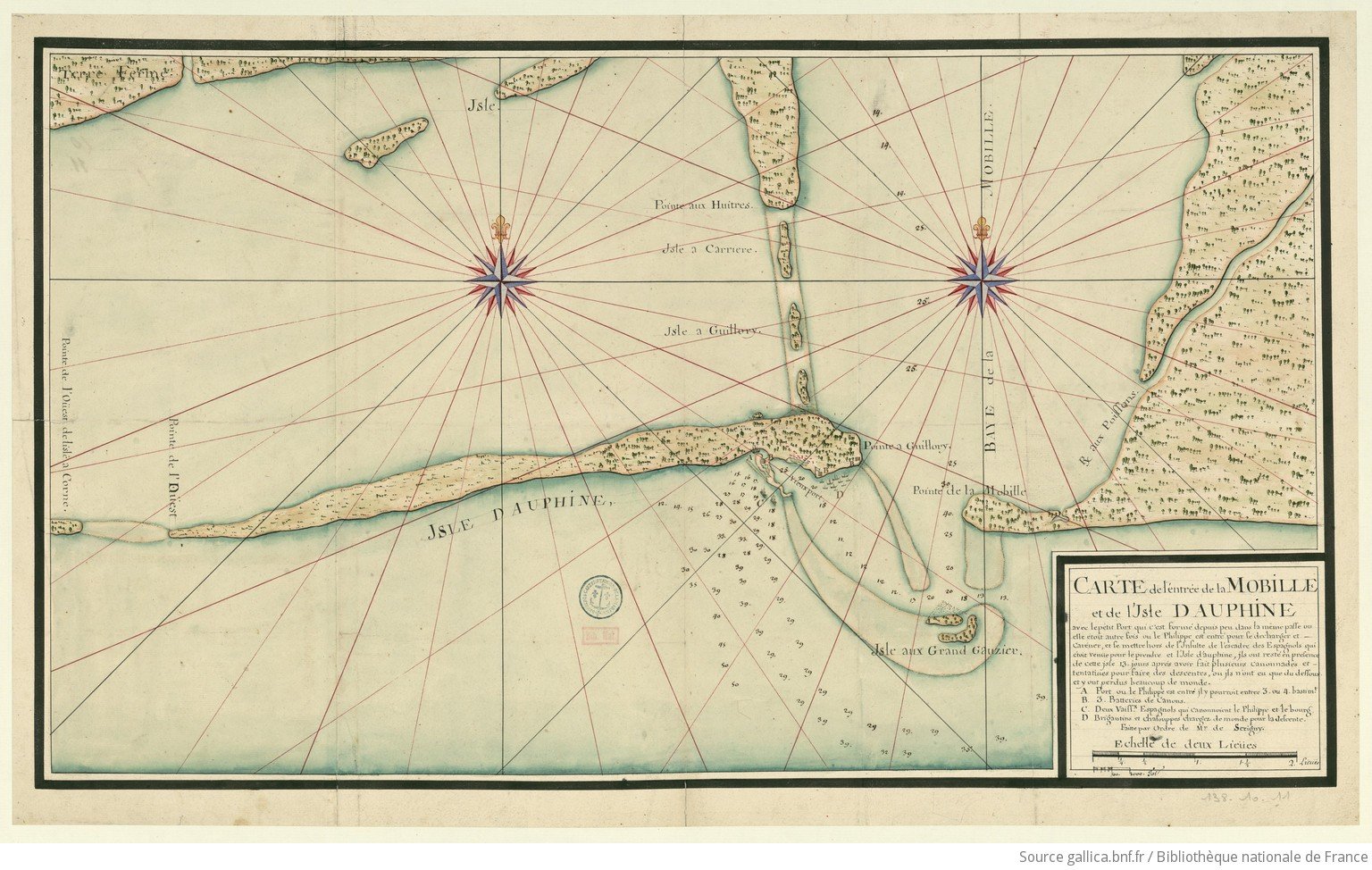
“Carte de l’Isle Dauphine,” French hydrographic chart of Dauphin Island and Mobile Bay entrance.
Source: gallica.bnf.fr / Bibliothèque nationale de France (Public Domain).
Lovers’ Oak — Memory and Legend
Among the Island’s early stories is that of Lovers’ Oak, an oak tree once said to stand near the shoreline.
As it appears in early printed sources, the tree became associated with a young woman who waited at the oak for the return of her beloved — a sailor who never came back. Whether the story is literal or symbolic, it attached longing and devotion to a specific place.
The tree itself is gone now.
But its name endured — passed down, written down, remembered. It became one more layer laid across the Island’s earlier names and meanings.
Violence.
Royal designation.
Romantic legend.
Each era leaving its mark.
Fort Gaines — Another Layer
By the mid-nineteenth century, the Island would again take on a different role. Fort Gaines rose along its western shore, guarding the entrance to Mobile Bay.
In 1864, during the Battle of Mobile Bay, Admiral David Farragut’s fleet forced its way past the defenses — the battle remembered for his reported command, “Damn the torpedoes.”
The Island had shifted once more — from colonial outpost to military stronghold.
Conflict, occupation, celebration — each leaving its imprint.
The names changed.
The purpose shifted.
The shoreline remained.
Layer upon layer, the Island absorbed story after story — and uncovering them has been an adventure.
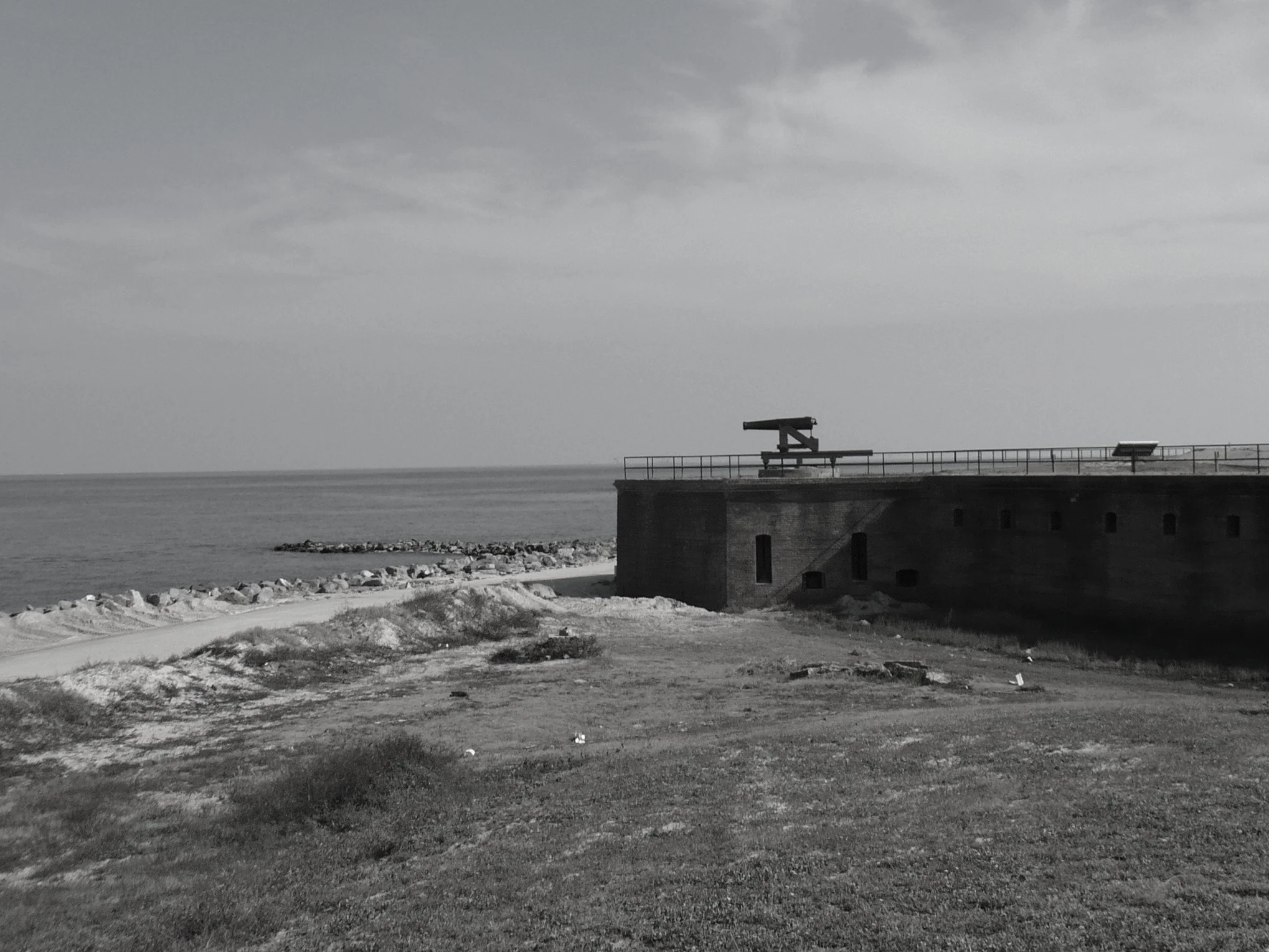
Fort Gaines, Dauphin Island.
Built in the 1820s and strengthened before the Civil War, the fort remains one of the Island’s most enduring historic landmarks. Public domain image via Wikimedia Commons.
When the Stories Are Told Again
For most of my life, “Massacre Island” was simply a name I had heard. Like many locals, I knew of the shell mound. I had heard the dramatic version of skulls piled high along the shore. The name carried a kind of inherited mystery — something passed along in conversation more than in context.
I did not know about the early oak tree. I did not realize how quickly the Island’s name had changed in official record. I had never stopped to ask what the earliest documents actually said.
That began to shift only recently, when I started reading more closely — comparing dates, looking at early references, and tracing how the story had been told over time.
And then one winter evening, standing beneath flambeaux light at Fort Gaines, I watched the Island’s origin story unfold in a carefully staged historical reenactment known as tableau — a scene performed in costume, recreating the moment of first arrival. It was not presented as debate or correction. It was simply told — as it has been told for generations — and I realized how deeply these layered stories shape the way we see the place we call home.
Sources & Further Reading
Hamilton, Peter J. Colonial Mobile. 1897.
Kennedy, Jo Myrle. Dauphin Island: Alabama’s French Possession, 1699–1763.
Rayford, Julian Lee. Whistlin’ Woman and Crowin’ Hen. 1956.
Raley, Leon G. Encyclopedia Mobiliana. 1963.
Roche, Emma L. “Romantic Dauphine Island.” Unpublished manuscript drafts.
Pickett, Albert James. History of Alabama. 1851.
Mobile Bay Magazine. May 2017; November 2024.
The Weekly Register (Mobile, Alabama). July 2, 1887.
Newspaper feature article. June 20, 1948.
Additional regional historical articles and archival materials consulted at the Local History & Genealogy Library.